A few weeks ago I released Graft, a review layer for pull requests written by agents. The idea behind it was simple: when an agent writes the code in ten minutes, the slow part of the job is no longer writing. It’s everything after. Someone has to understand the change, and something has to check that it works.
Graft was my experiment on the first half, the review. This post is about the second half: continuous integration. The project is called Ichnos, and its first version, v0.1.0, came out today with a website, documentation and a narrated video.
First, the name (yes, Greek again)#
After Horae, Angelia and Paeon, you know the routine. A bit of culture never hurt anyone.
Ichnos (ἴχνος) means track, footprint: the mark a foot leaves on the ground. The word is still with us in ichnology, the science of trace fossils, which studies dinosaurs from their footprints rather than their bones.
The best story about footprints in Greek mythology is told in the Homeric Hymn to Hermes. On the day he is born, baby Hermes steals fifty cows from his brother Apollo. To cover his tracks, he makes the herd walk backwards and ties branches under his own feet. Apollo follows the strange footprints anyway, finds the thief in his cradle, and the whole thing ends in front of Zeus. Sophocles later turned the story into a satyr play, the Ichneutae, “the Trackers”, where a chorus of satyrs looks for the cows by following their traces.
That’s the job of this project: read the tracks a command leaves behind, and deduce from them whether it really needs to run again. No god is involved, just a lot of openat calls.
1. Where the time goes when code is cheap#
I have the feeling on my own projects, but a feeling isn’t a measure. So I looked for numbers. They all tell the same story: agents make more changes, bigger changes, and the time moves to what comes after the code.
More changes than ever. GitHub’s Octoverse 2026 (October 2026) counts 1.3 billion merged pull requests in a year, more than three times two years earlier. In September, more than 40% of pull requests were started with an agent, against 17% in March. And GitHub Actions ran 1,440 jobs every second, 124 million a day, more than three times the previous year.
The review is the new queue. Faros AI measured it twice on telemetry from thousands of teams. In 2025, teams with high AI adoption merged 98% more pull requests, each 154% bigger, and the review time went up 91%. In the 2026 edition (22,000 developers), the median time a pull request spends in review is up 441%, and pull requests merged without any review are up 31%. LinearB’s 2026 benchmarks (8.1 million pull requests) say pull requests opened by agents wait 5.3 times longer before someone picks them up.
CI pays the bill too. CircleCI’s 2026 State of Software Delivery (28.7 million workflows) sees daily workflow runs up 59% in one year, the biggest jump they’ve ever measured. But the success rate on the main branch fell to 70.8%, the lowest in five years, and for the median team the throughput on feature branches went up 15% while the one on main went down 7%. More code goes in, less comes out green.
And at the extreme, Anthropic. In the article that started Graft, Anthropic explains that it went from about 2,500 merged changes a day in May 2026 to more than 30,000 in September, with about 25 million checkouts a day for CI. Their answer included giving up the global merge-queue lock and testing after the merge.
Google’s DORA reports show the same tension from another angle: in 2024, more AI came with an estimated 7.2% less delivery stability; in 2025, throughput is up but “instability continues to rise”. AI, they write, is an amplifier.
Two warnings on these sources. Faros, LinearB and CircleCI sell tools for exactly this problem, so they have an interest in describing it. And these are correlations, not controlled experiments. But they point in the same direction, and that direction matches what I see on my repositories: the agent writes the change in minutes, then the change waits for a human and for the pipeline.
That’s why I’m doing two experiments, one on each side:
| Step | What got slower with agents | My experiment |
|---|---|---|
| Writing the code | nothing, it’s the part that got fast | |
| Review | more and bigger pull requests, for the same humans | Graft: read a checked intent card before the diff |
| CI | more runs, same tests re-run on every change, red main | Ichnos: don’t run what can’t have changed |
2. How I work on these projects#
A word on method, because it matters more than the tool.
Graft, Paeon, Ichnos: all these projects are experiments I run on my own open-source projects. I have about fifteen public repositories, most with agents opening pull requests every day, and they are my test bench. An idea goes into one of them only after I’ve measured that it’s worth it, and it stays only if it keeps its promise on real history.
The code of Ichnos was written with Claude Code, in a single long session. But “an agent wrote it” is not a guarantee of anything. The rule I give myself is the same as for a human colleague: I don’t let anything skip a test until I can prove a skip is never wrong. So most of the work in this project wasn’t writing the tool, it was checking it: replaying real merges, running every skipped test anyway, comparing the results. That audit found three bugs that the unit tests had missed. I’ll come back to them.
3. The question I started from#
It started with a very practical question on one of my repositories: in GitHub Actions, is there a simple way to know, for each commit, which parts of the workflow are worth running?
The usual answer is a path filter: paths: in the trigger, or actions like dorny/paths-filter. “Run the docker job only if Dockerfile, scripts/ or web/ changed.” It works on day one. Then the project lives: a test starts reading a new config folder, a script moves, a template appears. Nobody updates the filter, because nothing breaks when it’s wrong. It just stops running a test it should have run. A path filter is a dependency map written by hand, and it goes stale silently.
My first idea was to put an LLM in front of the pipeline: give it the diff and let it decide what to run. I dropped it quickly. It costs money on every commit, it’s not deterministic, and above all it’s the wrong kind of tool for the job: the question “which files does this test depend on?” has an exact answer. You don’t need to guess it, you can observe it.
Looking at my repositories, I noticed that the information was already there, scattered: a COPY line in a Dockerfile, a list of copied files in a test sandbox, a mkdocs.yml. Every job already declares or reveals its inputs somewhere. The CI just never reads them.
4. How Ichnos works#
One rule#
Everything rests on one sentence:
A command that passed is not run again while everything it read is unchanged.
There is no map to learn and no diff to compute. When a command runs, Ichnos watches which files it touches. If it passes, that set, the footprint, is stored next to the result. Next time, before running the command, Ichnos checks the footprint against the current files. Nothing changed? The command is skipped. Something changed? It runs, and the new run records a new footprint.
What a footprint contains#
Reading files is not enough. A test can also depend on a folder’s content, or on a file not existing. So a footprint holds four kinds of entries:
| Entry | Recorded when the command… | Runs again when… |
|---|---|---|
files | reads or executes a file | its content changes or it disappears |
exists | only looks at a path (stat, access) | the path disappears or changes type |
listings | lists a folder | an entry is added or removed |
absent | looks for a path that isn’t there | the path appears |
The last two are the subtle ones. A test that runs on “every skill in skills/” depends on the list of names in that folder: adding a skill must run it again, even if no existing file changed. And Python looking for a module in five places before finding it depends on the four places where it wasn’t: create a file with that name earlier in the path, and the import changes.
Entries are checked against the files git can see: tracked files, and untracked files that aren’t ignored. Ignored files are treated as build outputs, not inputs. Content is compared through git’s own blob hashes, so checking the footprints of 1,140 test classes takes 2 to 3 seconds.
Why it can’t go stale#
This is the part I like most, and it’s why there is no “learning” phase. A deterministic command can only start depending on a new file if something it already reads changes: a new import comes from an edited source file, a new config key from an edited config. That edit is in the old footprint, so the command runs again, and the new run records the new footprint. The check “nothing in the footprint changed” also guarantees that the footprint itself is still right.
In the first version of the plan, there was a separate step to learn a dependency map, refreshed every week. I measured it: after one week, the map had missed 395 real dependencies. Remembering results with their footprint, instead of maintaining a map, made that problem disappear.
How to see what a command reads#
You ask the kernel. Every time a program opens, lists or looks for a file, it makes a system call (openat, getdents64, newfstatat…). Ichnos records those calls, with two possible tracers:
eBPF (bpftrace) | strace | |
|---|---|---|
| Needs | root, or sudo without a password (GitHub’s runners have it) | nothing |
| How | the kernel reports each call when it returns; nothing is stopped | stops the process at each call |
| Cost on GitHub’s runners | about 1.3× the run time | 1.8× to 2× |
Both produce the same list of calls, read by the same rules. Without either one, or on macOS, the command just runs and is never skipped.
flowchart TD
    A["ichnos run --id tests -- pytest"] --> B{"Remembered result
for this command?"}
    B -- no --> R["Run under the tracer
(eBPF or strace)"]
    B -- yes --> C{"Footprint still holds?
files · exists · listings · absent"}
    C -- yes --> S["Skip: passed on the same inputs"]
    C -- no --> R
    R --> D{"Passed, and
nothing doubtful?"}
    D -- yes --> M["Remember the result
with its footprint"]
    D -- no --> N["Report it, remember nothing
(a failure never allows a skip)"]
The traps#
Reading syscalls is easy. Turning them into a correct footprint is where the work is. A few cases I had to handle, almost all found on real repositories:
- Copies are not dependencies. One of my test suites copies the whole
scripts/folder into a sandbox before running an installer. Read naively, every test depends on every script: a median of 225 files per test. Ichnos follows copies (sendfile,copy_file_range, andcp/install/mvby name) and only keeps the originals of the files that were then read in the sandbox: 42 files. A copy it doesn’t recognise counts as a read, which costs precision but never correctness. - Bytecode stands for its source. Reading
__pycache__/x.cpython-312.pycmeans depending onx.py. - A run that modifies a file it read is not remembered. Its result depends on its own history.
- Anything doubtful means “run, but don’t remember”. Events lost by the tracer, a path too long, an unknown file descriptor: the test runs and the reason is printed.
- io_uring,
chrootand 32-bit programs are detected with eBPF and never remembered. Withstracethey go unnoticed. On a real project, eBPF found 3 test classes using io_uring thatstracehad remembered without seeing what they read.
Some things can’t be traced at all: tool versions, the runner image, the network, the clock. Those go into the key with --key "$(python --version)", and a scheduled run with --no-skip catches the rest.
Where the memory lives#
Results have to be shared between CI runs: the pull request runs the tests, main should be able to reuse them. The Actions cache doesn’t fit: a cache created by a pull request is only readable by that same pull request, and entries are evicted after 7 days.
So Ichnos stores its memory in the project’s own git repository, under a dedicated ref, refs/ichnos/memo. No branch or tag points to it, clones don’t download it, and it’s a single commit without parents, replaced at every publish, so the repository doesn’t grow. Committing the memory to a branch was ruled out: on my biggest repository it’s about 8 KB per test class, and most of it changes every week.
And since whoever can write the memory can make CI skip a test, records can be signed with a secret (ICHNOS_SIGNING_KEY) that pull requests from forks can’t read. Unsigned records are then ignored. That one came out of an automated security review during development, and it was right.
5. Three ways to use it, safest first#
While measuring, I realised the biggest gain didn’t need any tracing at all. So Ichnos offers three modes.
1. Ask GitHub what the pull request passed. When a pull request was up to date with main, the push that follows its merge has exactly the same files as the pull request’s last commit. The tests on main repeat a run that just passed. Ichnos asks GitHub three questions: is this commit the merge of a pull request, does that pull request’s last commit have the same git tree, and did the named jobs succeed there? If so, they’re skipped. Nothing is stored, no write access is needed, any doubt or API error runs everything.
jobs:
  changes:
    runs-on: ubuntu-latest
    permissions:
      contents: read
      actions: read        # the jobs of the pull request's run
      pull-requests: read  # which pull request this commit merged
    outputs:
      seen: ${{ steps.ichnos.outputs.seen == 'true' }}
    steps:
      - uses: actions/checkout@v7
        if: github.event_name == 'push'
      - id: ichnos
        if: github.event_name == 'push'
        uses: mmornati/ichnos@v0
        with:
          passed-in-pull-request: |
            test

  test:
    needs: changes
    if: needs.changes.outputs.seen != 'true'
    runs-on: ubuntu-latest
    steps:
      - uses: actions/checkout@v7
      - run: make test
2. Remember that a whole tree passed. A docker build or a browser test can’t be followed file by file. Ichnos can still remember, in the shared memory, that this exact set of files already passed a job: one hash over every file git can see. It skips re-runs of an unchanged commit and the run on main after a merge.
3. Trace every command. The full mode described above: ichnos run --id tests -- pytest, or ichnos batch to split a test suite into units (one per unittest class or pytest file) and only run those that a change can reach. This is the experimental one.
6. What I measured#
Is a skip ever wrong?#
This is the only question that really matters. A tool that skips a test that would have failed is worse than no tool.
I took the 12 last merges of ai-running-coach (1,130 test classes, many of them testing an installer in a sandbox). At each merge, Ichnos ran with the memory built so far. Then every class it skipped was run anyway, and its result and footprint compared.
| Final audit | |
|---|---|
| Skips audited (run anyway) | 8,126, out of 13,537 class runs |
| Skipped classes that failed when run | 0 |
| Skipped classes whose footprint differed | 0 |
| Test time skipped | 43% |
The word final is important. The audit ran three times, and the first two found real bugs:
- Copying a
.pyccounted as reading its source. Some footprints went from about 15 files to about 100. A safe error (needless runs), but an error. stracepads short lines with spaces, and Ichnos dropped them. About one call in a thousand was lost. A lost read means a file missing from the footprint, so a wrong skip was possible. It showed up as 10 footprints that differed between two runs of the same test.- A flaky test was skipped once.
ReviewFixTestsfails in the container 12 times out of 13. It passed once by luck, the pass was remembered, and the next merge skipped it. Ichnos now remembers failures too: two different results on the same files mark a test as flaky, and it always runs for 14 days. A pass right after a failure has to happen twice before it can be skipped.
None of these three bugs was caught by Ichnos’s own unit tests. They were caught by running the tool against real history and checking every decision. That’s the whole point of the method.
How much time does it save?#
Here is the part where I have to be honest: on ai-running-coach, tracing every test doesn’t save waiting time. Skipping 43% of the test work is real, but a handful of modules (coach_config.py, arc_contract.py) are read by more than 800 classes, and 18 of the last 100 commits touch one of them. Those merges run everything, with the tracing cost on top, and they cancel the gain of the others. Coupling in the code, not the tracing rules, sets the limit.
The tracing cost itself, measured on three GitHub-hosted runners on the whole suite (1,140 classes, 4 at a time):
| Runner | Plain | eBPF | strace | Second run, everything skipped |
|---|---|---|---|---|
| 1 | 461 s | 586 s (1.27×) | 823 s (1.79×) | 2 s |
| 2 | 631 s | 840 s (1.33×) | 1,237 s (1.96×) | 3 s |
| 3 | 445 s | 573 s (1.29×) | 853 s (1.92×) | 2 s |
The two tracers agree on 1,136 footprints out of 1,137. The one difference is a test that writes its own fetch-sparkle.sh in a temporary folder: the strace reader confused it with the repository’s file of the same name, eBPF didn’t.
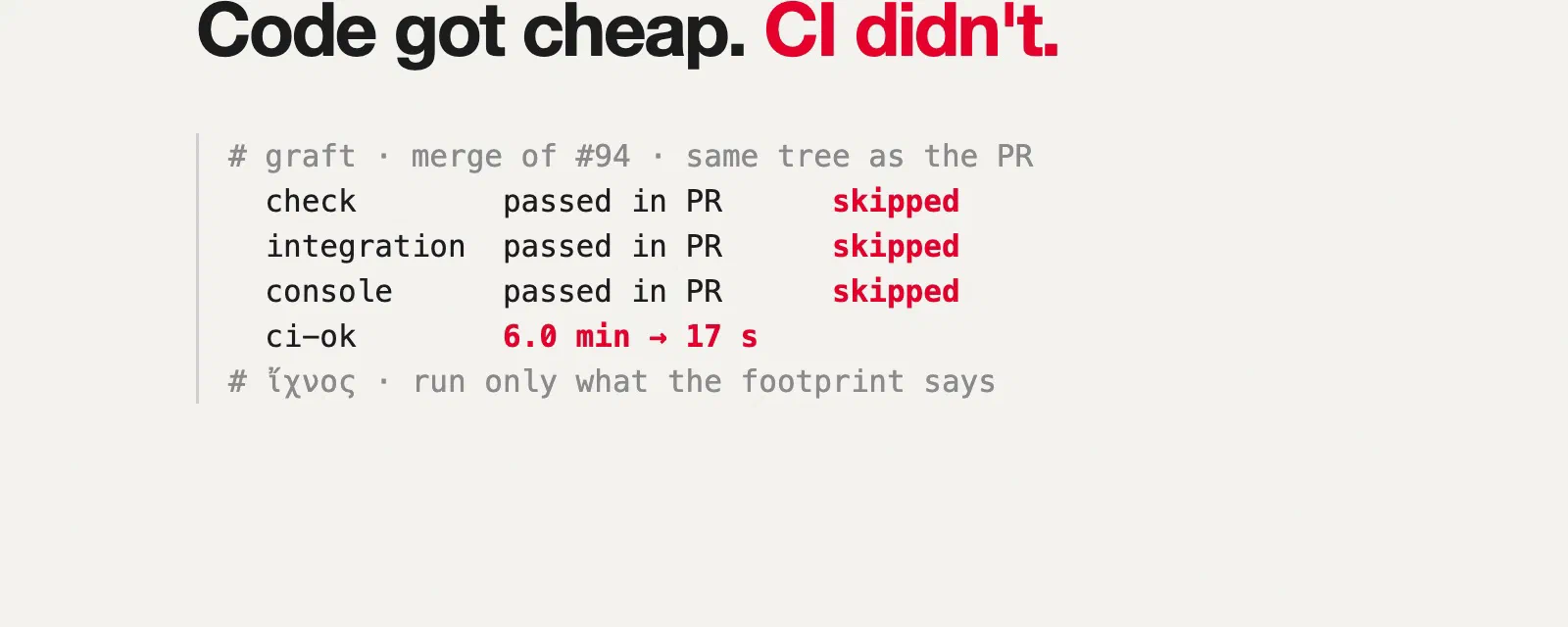
The safe mode is a different story. On my other repositories, between 37% and 98% of merges produce exactly the files the pull request was already tested on. I added mode 1 to four of them, and in each case the merge of the pull request that added it was the first real test:
| Repository | Run on main after the merge | Before |
|---|---|---|
graft | 17 s: everything skipped | 6.0 min median |
ai-running-coach | 18 s: the whole Tests workflow skipped | 3 to 11 min |
ai-nutrition-coach | 3.7 min: tests skipped, image build and publish still run | 5.9 min median |
leanproxy-mcp | Lint 30 s instead of 2.5 min; Test unchanged |
On leanproxy-mcp I left the test job running on main on purpose: its coverage report is the baseline Codecov compares pull requests with. On ai-nutrition-coach the image still builds, so that what gets published comes from tested layers. Knowing what not to skip is part of the job.
All my repositories are public, so GitHub runners are free for me: what I save is waiting time, not money. On a private repository the same minutes would be on the bill.
7. The others who solved this before#
I didn’t invent the idea of skipping what didn’t change. Before writing a line, I looked at what exists. The family is large, and the difference is always in what the tool asks of your repository in exchange:
| Tool | How it decides | What it needs |
|---|---|---|
| Bazel, Buck2, Pants (remote cache) | hash of the declared inputs of each target | a fully declared, hermetic build graph |
Nx affected, Turborepo | project graph, hash of the inputs of each task | a monorepo workspace and its configuration |
| Gradle Develocity Predictive Test Selection | a model trained on build history | Gradle or Maven, a Develocity server, a paid licence |
| CloudBees Smart Tests (formerly Launchable) | a model trained on test history | test results uploaded to their SaaS |
| Meta Predictive Test Selection | a model on past changes; halved test infrastructure cost while catching over 99.9% of faulty changes | Meta-scale history and the build graph |
| Datadog Test Impact Analysis | per-test code coverage; skips a test that passed where its files are identical | Datadog’s tracer, per language; data files and dependencies are not seen |
| pytest-testmon | Coverage.py, test by test | Python and pytest only |
| fabricate, memoize.py | strace on a build command, hash of the files it opened | it’s a build tool, not a CI tool |
| skip-duplicate-actions, skip-if-passed | skip a GitHub job that already succeeded on the same git tree | GitHub Actions |
| dorny/paths-filter | globs on the changed files | rules written and maintained by hand |
Two things stand out. The big systems (Bazel, Develocity, Meta) are excellent, but they ask you either to declare your whole dependency graph, or to send your history to a model. That’s a reasonable price for a company with thousands of engineers, not for a repository with three workflows. And the closest ancestor of Ichnos, fabricate, had the same idea more than fifteen years ago with strace, but for builds.
So Ichnos sits in a small gap: observed dependencies (no graph to declare, no model to train), applied to CI commands and tests, with the memory in your own repository. For mode 1, the “same git tree” idea already exists in skip-duplicate-actions; Ichnos looks job by job: the commit must be the merge of that pull request, and each named job must have really run and passed there. A job the pull request skipped doesn’t count.
8. The video#
Like Graft’s, the video isn’t a video file: every frame is drawn in JavaScript on a canvas, over a synthetic Kokoro voice (how it’s made). Eighty seconds, seven scenes: the problem, the rule, the footprint, the three modes, what was measured, what’s still experimental.
Press Play (sound on). Open it on its own page for chapters and subtitles. English only.
9. Honest limits#
- Tracing is Linux only. On macOS and Windows, commands run untraced and are never skipped.
- Tracing costs time: about 1.3× with eBPF, 2× with
strace, nearly 3× on a Node test suite. On tightly coupled code, most tests run anyway, so the cost isn’t paid back. - Not everything is a file. Tool versions, the network, the clock and environment variables are invisible. Keep a scheduled run with
--no-skip. - Tests with a time limit can time out under tracing: one 5-second test failed one traced run out of two.
- Only my repositories. Nobody else has used it. The audit was done on one Python project; Go and Rust haven’t been tried.
- Version 0. Options and the memory format can still change, and it isn’t on PyPI yet (the name
ichnosis taken there; the package will beichnos-ci).
10. Try it#
- Start with mode 1. A few lines in one workflow, nothing stored, no write access. The getting started page has the workflow and the three decisions to make (a single required check, jobs that must really run on
main, jobs that depend on the outside world). - Read the design and the findings before using the tracing mode: everything I measured is there, including what didn’t work.
- On your own machine:
pip install git+https://github.com/mmornati/[email protected], thenichnos doctortells you which tracer it can use, andichnos estimatereplays your git history to predict the saving before you change anything.
Code got cheap. Review and CI didn’t. With Graft and Ichnos I’m trying to push the weight back down where it can be pushed, but always the same way: measure first, prove that nothing breaks, and only then let a machine decide on my behalf.