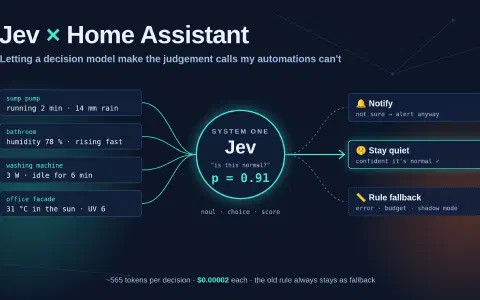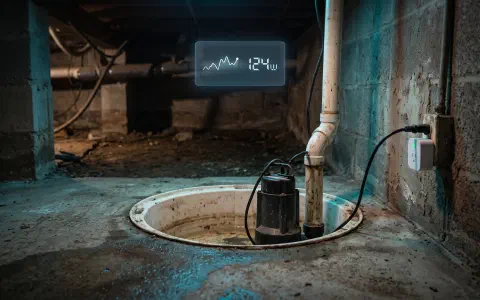

My previous post covered how I plugged Jev, TypeSafe’s decision model, into Home Assistant to answer the “is this normal?” question my threshold-based automations can’t: is the sump pump running long because it rained, or because the float is stuck; is the water flowing because of a shower, or a leak. The rule always computes its own answer, Jev only advises, and everything started in shadow mode so I could read the disagreements before trusting it.
That post got a comment on Mastodon that deserved more than a reply. Thanks to OneClickClaw for it:
@mmornati Feed the last few hours of readings to a small local model, it gets the context.
Fair question. My prompts really were snapshots - humidity now, flow now - and a shower and a slow leak can look identical for a few seconds. This post is what I did about it, and it isn’t what the comment suggested. I looked hard at running something locally, decided against it, and found that the actual gap had nothing to do with which model answers the question.
Why not a small local model, on my hardware#
The house I described the last time still runs on the same box I’ve mentioned before on this blog: an N100 mini PC, 4 cores, 16 GB of RAM, no GPU. It’s already carrying Home Assistant Core, the recorder database, Zigbee2MQTT, and everything else HAOS runs alongside it. There’s no spare accelerator sitting idle, and no second box I’d want to dedicate just for this.
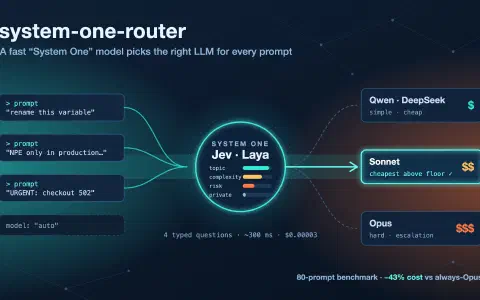
In the router post that started this whole thing, I benchmarked Laya, an open-weights model built for exactly this kind of typed decision, and the numbers already answered the question I’d be asking now: on an Apple GPU it’s fast, but on a Raspberry-class CPU - which an N100 is closer to than to a GPU box - expect 1.5 to 3 seconds per call. My decisions fire every 5 minutes for the VMC alone, several of them run in parallel (mode: parallel on purpose, so a flapping trigger doesn’t queue behind a slow one), and some share the box with the Zigbee coordinator that’s supposed to react to a button press in real time. A few seconds of CPU contention, six times an hour, forever, is not a rounding error on 4 cores - it’s a tax on the thing the box actually has to do.
And that’s for a model designed to be small. Loading even a distilled general-purpose LLM (a small Llama or Qwen) adds a few gigabytes of RAM just sitting there, on a machine where 16 GB is the whole budget, not a headroom number. The maths from the last post already said it plainly: local only makes sense on its own hardware, and buying a second mini PC to save $3 a year is not a serious trade.
The part that would have been wrong even with better hardware#
Here’s the thing I only realised while checking the numbers: the local-model idea assumes the problem was Jev’s intelligence. It wasn’t. Jev has a 32k-token context window and I was using about 565 tokens of it. The ceiling was never the model - it was that I was only ever sending it the current value. A small local model with a 512-token window would have hit the same wall faster, not solved it.
So the fix wasn’t to swap Jev for something else. It was to stop starving it.
What I built instead#
Five additions, all inside the existing shadow/active pattern, none of it changing which model answers the question.
1. Compact history, not raw readings#
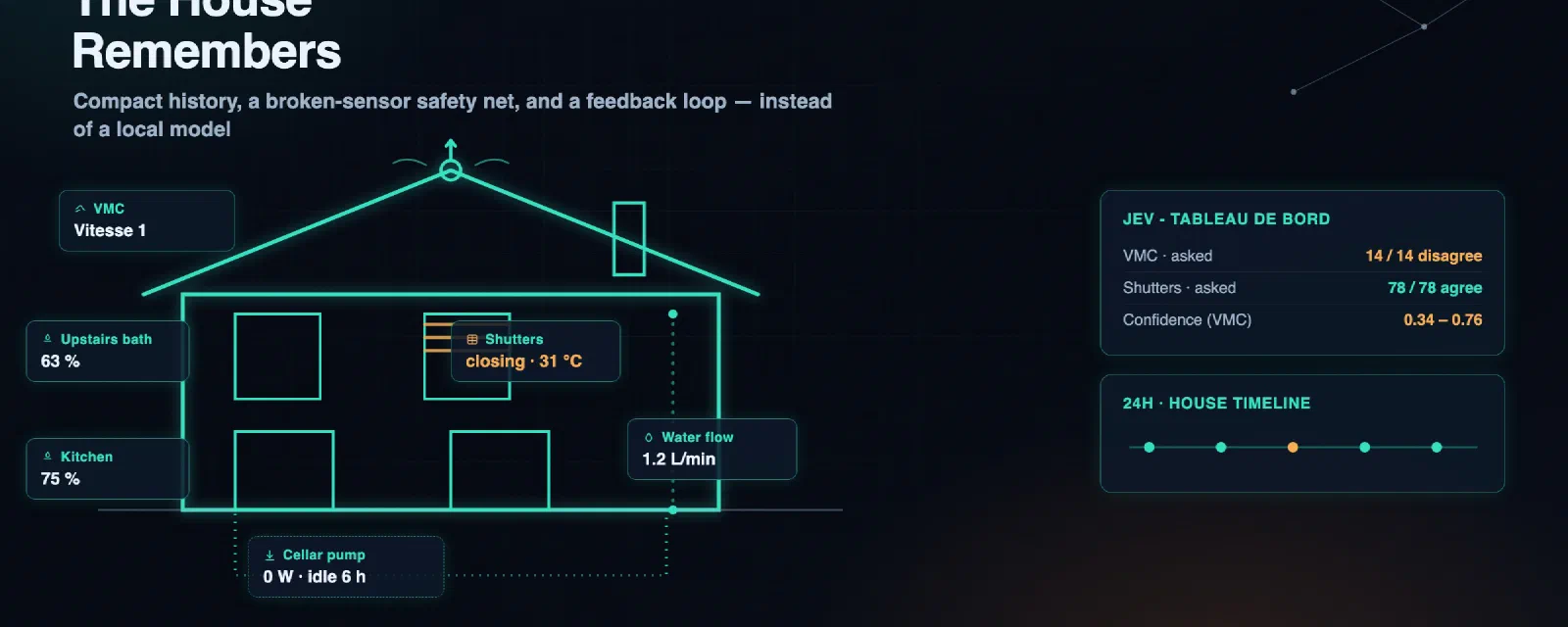
A new shared script, script.jev_history, calls Home Assistant’s own recorder.get_statistics and resamples it into short series a model can read at a glance - one value per step, plus min, max, and the largest rise or drop with when it happened:
- action: script.jev_history
  data:
    sensors:
      water flow L/min: sensor.water_monitor_general_water_flow_l_min
      upstairs bathroom humidity %: sensor.temperature_sensor_salle_bain_etage_humidity_2
      parents' bathroom humidity %: sensor.temperature_sensor_salle_bain_parents_humidity_2
      kitchen humidity %: sensor.temperature_sensor_cuisine_humidity_2
    hours: 3
    every: 15
That’s about 40 tokens per sensor instead of hundreds of noisy raw states, and it’s exactly what tells a shower from a leak: a shower is 8-12 L/min for ten minutes with bathroom humidity climbing during that window; a leak is a low, flat flow for hours with nothing else moving. jev_history now runs ahead of all six decisions - pump, water, temperature drop, shutters, VMC, laundry.
Alongside it, a 24-hour rolling sensor.house_timeline keeps the last 25 house events (“washing machine started”, “someone arrived home”, “VMC set to Vitesse 2”) without naming who or where, so a decision can also see what just happened, not only what the numbers look like.
2. A humidity baseline, because “high” is relative#
A room that always reads 72% isn’t steaming at 72%, and blowing outdoor air through it doesn’t dry anything if the outdoor air holds more water than the room does. Two new pieces close that gap: a statistics sensor tracking each wet room’s own 24-hour median, and a template that turns temperature and relative humidity into absolute humidity in g/m³ - the number that actually tells you whether ventilating helps. The VMC decision now gets both, alongside the raw percentages.
3. A safety net for the exact bug the last post found#
The previous post’s nicest accidental discovery was that two humidity sensors had been stuck at 0% for who knows how long, quietly feeding both the old rule and Jev a wrong number. That shouldn’t have to wait for a blog post to be noticed, so there’s now a shared sensor_health.jinja: every sensor a decision depends on gets checked for being missing, unavailable, out of a plausible range, or silent for too long. When one is broken, Jev is told explicitly which values aren’t real (“unreliable sensors: highest living-room humidity (implausible value)”), its answer is never trusted for that call, and a safe_answer (usually “keep doing what you were doing”) wins over the rule too - because the rule is reading the same broken sensor and has no idea it’s lying.
4. One mode switch per decision, not one for the whole house#
input_select.jev_mode used to be a single switch for six very different questions. It’s now input_select.jev_mode_vmc, _eau, _pompe, _temperature, _volets, _linge, each defaulting to global (follow the main switch) but able to go active or off on its own. That turned out to matter faster than I expected - see the numbers below.
5. A feedback loop, so I don’t have to eyeball the logbook forever#
Every time Jev and the rule disagree, a phone notification can now ask “who was right?”, with two buttons. The answer fires an event, which lands on a new sensor.jev_scoreboard: per decision, how many times Jev was asked, how often it disagreed with the rule, and who the feedback said was right, plus the token cost. A Sunday-evening automation reads the scoreboard, posts a weekly summary, and resets the count for the next week. I also wrote up a short review process (docs/jev-weekly-review.md) for reading the shadow logbook, the scoreboard, and the history around each disagreement, and turning that into a pull request - the same shape of session that built the feature in the first place, pointed at reviewing it instead.
None of this required a different model, a second machine, or leaving the shadow pattern. It required sending Jev the facts a person would actually use to judge the same situation.
What the house is actually saying, right now#
I pulled this straight from the live instance while writing this section, so it’s what’s really happening, not an estimate.
Today (26 September, checked mid-afternoon UTC): 267 Jev calls, 205,974 input tokens, $0.0087 so far. Over the trailing week, the daily average is about 116 calls and a median cost around $0.0027/day - a slow day and a busy day can differ by a lot, which is expected once the VMC only asks when something actually changed rather than on a fixed timer.
The scoreboard is only hours old (I reset it when this shipped), and it’s already telling a useful story:
| Decision | Asked | Disagreed with the rule | Jev’s confidence |
|---|---|---|---|
| VMC (choice of 3 speeds) | 14 | 14 (100%) | 0.34 - 0.76, always below the 0.6 bar that would let it act |
| Shutters (yes/no) | 78 | 0 (0%) | consistently confident |
Pulled straight from the shadow logbook over the last 24 hours, that’s not a fluke - every one of about 115 VMC calls disagreed with the rule, always at a confidence too low to matter even in active mode, while every one of the shutter calls agreed with it. Two decisions, wired the same way, behaving completely differently. That’s exactly why the per-decision switch exists: the shutters could go active today with nothing left to check; the VMC clearly can’t yet, and now I have a scoreboard instead of a gut feeling telling me so. My guess, to verify next: the VMC’s own rule already reacts to short humidity spikes with hysteresis, so a lot of what looks like “disagreement” is Jev and the rule picking different speeds during the same transient rather than either one being wrong - which is precisely the kind of thing the weekly review process exists to dig into once there’s a full week of feedback answers to read.
“Isn’t this what the Bayesian sensor is for?”#
Another comment, from Niall O’Callaghan, on the same thread as the local-model one:
@mmornati is this not what the Bayesian sensor is for?
Home Assistant’s own Bayesian sensor has been doing “combine several clues into one probability” for years, entirely locally, for free. It’s a fair question, and the honest answer is: close, but not quite - and the gap is exactly the two things this post is about.
A Bayesian sensor takes a prior (how often the thing is true in general) and a list of observations - each one a state, numeric_state or template condition, with two numbers you supply: prob_given_true and prob_given_false, how likely that observation is if the thing is true or false. It multiplies them together (naive Bayes) and flips to on once the result clears probability_threshold. Entirely local, instant, free, deterministic, and every number is yours to tune from your own history.
Where it runs into the same wall as a plain threshold:
- You have to know the probabilities. “How likely is 14 mm of rain, given that the pump is behaving normally?” is a guess dressed up as a number, and a wrong guess is still a confident-looking one.
- It’s binary, full stop. One Bayesian sensor is one
on/off. The VMC decision needs a pick among three speeds with a confidence on each - that’sjev.choice, returning a whole distribution that sums to 1. To get there with Bayesian sensors you’d need three of them, voting, with no guarantee their probabilities add up to anything sensible. - Numbers become buckets, and clues are assumed independent. A
numeric_stateobservation only fires above or below a line, so 11 L/min and 25 L/min land in the same bucket. And bathroom humidity climbing because the water is flowing is two pieces of the same fact, counted twice, unless you remember to model that yourself. - It has no idea when its own inputs are lying. Feed it the humidity sensor that was stuck at 0% for who knows how long, and it multiplies that lie into the posterior with exactly the confidence you configured, same as the old VMC rule did. The
sensor_health.jinjasafety net earlier in this post exists precisely because nothing in the Bayesian sensor itself would have caught that. - No memory, either. A Bayesian sensor reasons over the current state of its observations, not “humidity rose 6 points in 15 minutes then held” - the exact shape
script.jev_historyexists to describe.
None of that makes it a bad tool. For a signal you already understand well and want to keep entirely offline and deterministic - occupancy from motion and door sensors is the classic example - a hand-tuned Bayesian sensor is genuinely the better choice: no network call, no per-call cost, the same answer every time. The two combine nicely, in fact: a Bayesian sensor’s probability can be one more line in the facts Jev gets, and HA-Jev’s own jev.calibrate action - comparing a probability sensor’s past values against what actually happened - can suggest a threshold, borrowing back a bit of the “tuned on my own house” advantage a hand-rolled Bayesian sensor has and a general-purpose model doesn’t start with.
Worth trying next#
Two things I haven’t done yet, both natural next steps from what’s already in place:
- Calibrate the VMC with its own history. HA-Jev’s
jev.calibrateaction compares a probability sensor’s past values against what actually happened and suggests a threshold. With a growing scoreboard and logbook, the VMC decision finally has enough of its own data to be tuned on, instead of relying on Jev’s general-purpose calibration. - Feed Laya the same history, in shadow, for free. The local-model idea wasn’t wrong to want context - it was solving the wrong layer. Now that
jev_historyproduces a small, resampled JSON series for every decision, it’s also exactly what a 512-token local model would need, and cheap to try: log a third column next to Jev and the rule, no phone notifications, just numbers to compare in a few weeks.
If you’re running Jev or a similar decision model in your own automations, I’d like to know whether you found the same thing - that the missing piece was memory, not intelligence. Tell me in the comments, or reply on Mastodon like the last one.