
On September 13, 2026, at 2:00 AM, I lined up at the start of the Ultra 110 km Trail Côte d’Opale in Wimereux, France. 15h26 later, I crossed the finish line. Between those two moments, there was more than just training: there were months of planning, analysis and adjustments — and a good part of that work was done with the help of AI agents.
I don’t want to tell you about my race or my training sessions: I want to use all this data to show you how planning backed by AI-analyzed data can help you prepare a race properly, whatever it is.
In this article, I’ll tell you how I used ai-running-coach, an open-source project I created, to prepare for this goal: the periodized training plan, nutrition, analysis of my Garmin data, and race strategy all the way to race day.
The project: specialized AI agents, connected to Garmin#
ai-running-coach is a project 100% in French that provides AI agents and skills to help runners prepare for a goal (race, trail, ultra) directly in their favorite IDE (Claude Code, OpenCode, Gemini CLI, Cursor, Windsurf).
The project is built around 4 specialized agents:
| Agent | Role |
|---|---|
| 🧠 coach | Plans periodized training, adjusts based on constraints (weather, health, personal life) |
| 🗺️ course-strategist | Analyzes courses (GPX), defines paces and race strategy |
| 🩺 medical | Analyzes health data (HRV, resting HR, sleep, readiness) and weather |
| 🥗 nutritionist | Builds training and race nutrition plans |
Plus 8 skills: GPX analysis, course comparison, Garmin planning, weather, session analysis, etc. Access to Garmin Connect goes through garmin-mcp, with a whitelist of tools.
Installation is a single command:
git clone https://github.com/mmornati/ai-running-coach.git
cd ai-running-coach
./install.sh
The script automatically configures Garmin access, the working folders (activities/, medical/, nutrition/, planning/, rapports/, resources/) and the integration with your IDE.
All the work is done in markdown, in French, in a structured workspace. Every session, every report, every plan is a file you can re-read, version and share. That’s exactly what I did for 8 months.
The goal: the Ultra 110 km Trail Côte d’Opale#
My goal was clear: 109.8 km, +1768 m of elevation gain, 2:00 AM start, along the Opal Coast (sand, dunes, cliffs, wind). A demanding course, with time barriers to respect:
| Point | Km | Barrier |
|---|---|---|
| Châtelet | 42.4 | 09:00 |
| Hervelinghen | 77.6 | 14:30 |
| Cap Gris-Nez | 94.1 | 17:00 |
| Finish | 109.8 | 19:35 |
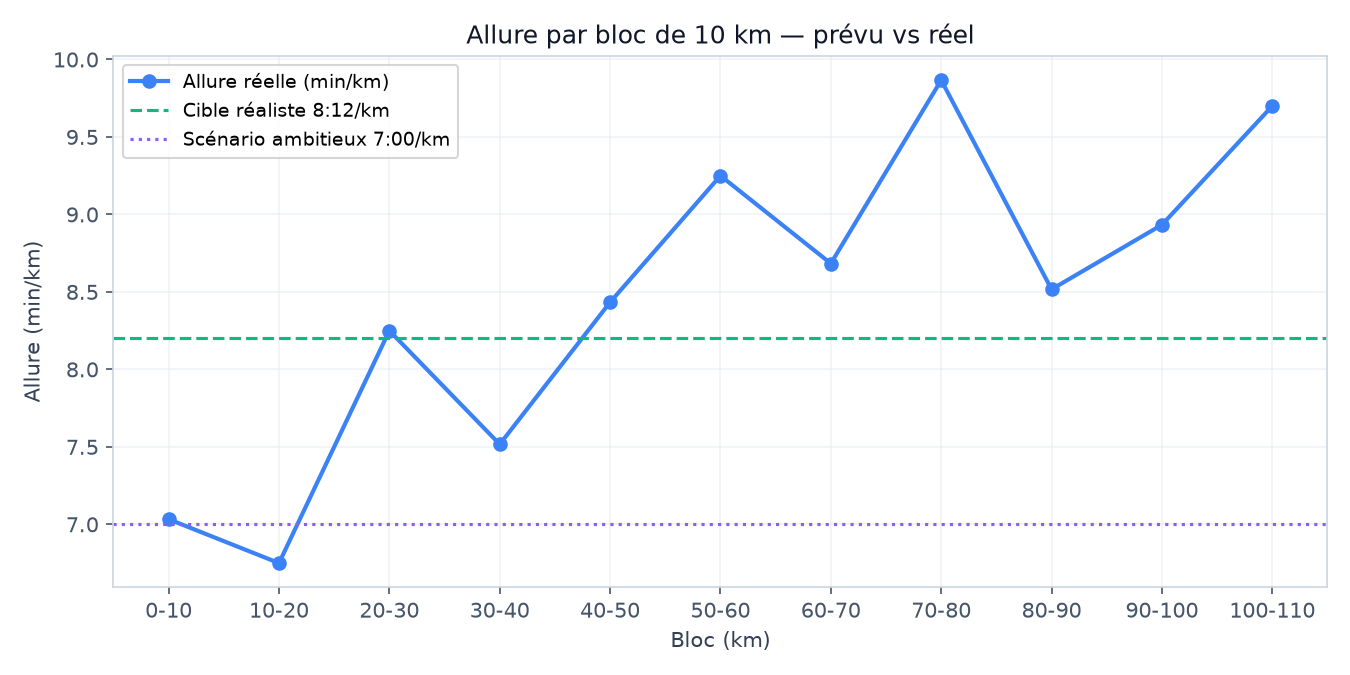
With the coach, we defined a realistic target of 15h00 (average pace 8:12/km), an ambitious scenario at 12h49 and a safety scenario at 16h00. The heart rate rule was simple: never above 140 bpm, with a target of 116-133 bpm (Z2).
The periodized training plan#
The plan was built period by period, from the start of the year until race day, with constant adjustments based on my personal constraints, the weather and my health.
The final phases (S1 → S5)#
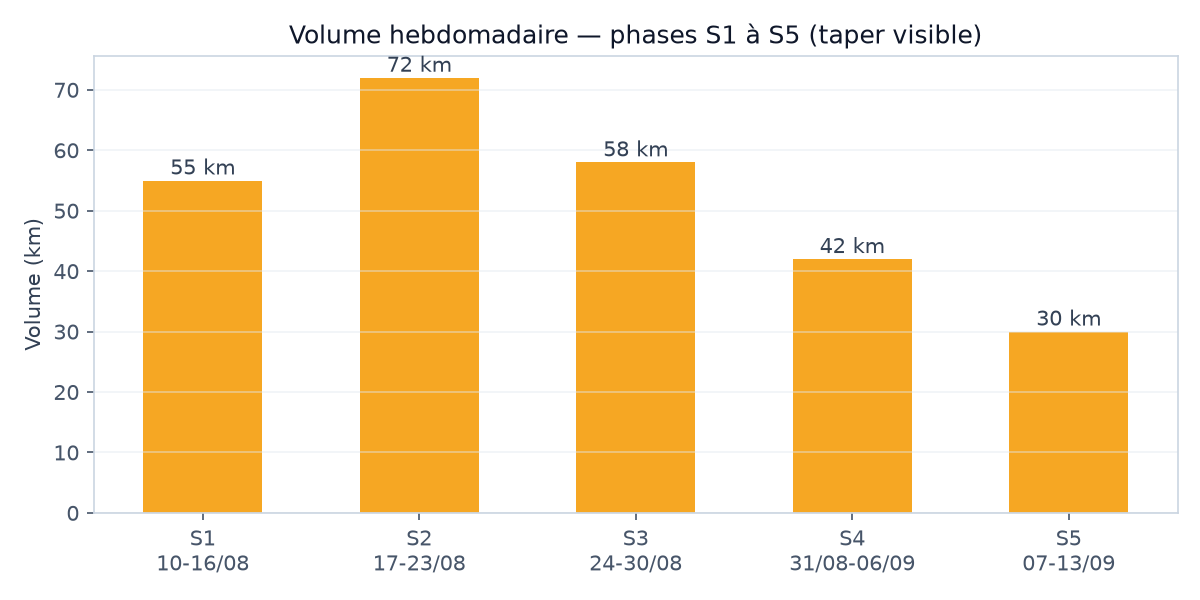
The last 5 weeks illustrate the logic well:
| Phase | Period | Content | Volume |
|---|---|---|---|
| S1 | Aug 10-16 | 48 km long run (Vicere-Mara-Sanprimo) | ~55 km |
| S2 | Aug 17-23 | Maximum volume, dune runs | ~72 km |
| S3 | Aug 24-30 | Summer vacation + 30-40 km PEAK (nutrition test) | ~58 km |
| S4 | Aug 31-Sep 6 | Taper -40% | ~42 km |
| S5 | Sep 7-13 | Taper -60/-70% + race | ~30 km |
Adjustments along the way#
What makes the difference is the ability to adjust. A few concrete examples:
- Illness mid-June: 14 days without training. The plan was rebalanced, without panic, by shifting the peaks.
- Summer vacation (S3): the coach integrated the heat as a constraint, with shorter morning runs and afternoon walks.
- Weather: every long run was preceded by a weather analysis (via the dedicated skill), with adjusted start windows.
- The 48 km run cut to 38 km: on Aug 10, the planned 48 km long run was reduced to 38.5 km. Why? The recovery analysis (readiness, HRV) showed the body wasn’t ready. Result: a 38.5 km / +1849 m run in 6h09 at 133 bpm — 9 bpm less than the same run in 2024. Proof that listening to the data pays off.
Not just running#
The plan wasn’t only running. The Garmin data shows real variety:
- Trail: the long runs (38.5 km Albavilla, 30.9 km Tournai, 30.5 km Tournai PEAK)
- Hiking: the Cinque Terre on vacation (10.4 km, 3h30) — easy volume
- Walking: on vacation, active recovery
- Indoor cycling: 2 sessions in June-July
- Strength training: phase 3 strength circuit, light strength during taper
This variety is a real asset for an ultra: it maintains volume without hammering the joints.
Nutrition: tested, then planned to the gram#
Nutrition was a major focus. The approach: test during training, then plan precisely for race day.
The Aug 30 test (peak run)#
On Aug 30, during the 30.5 km peak run, I tested the full nutrition protocol: products, rotations, timing. That’s what validated the plan for the race.
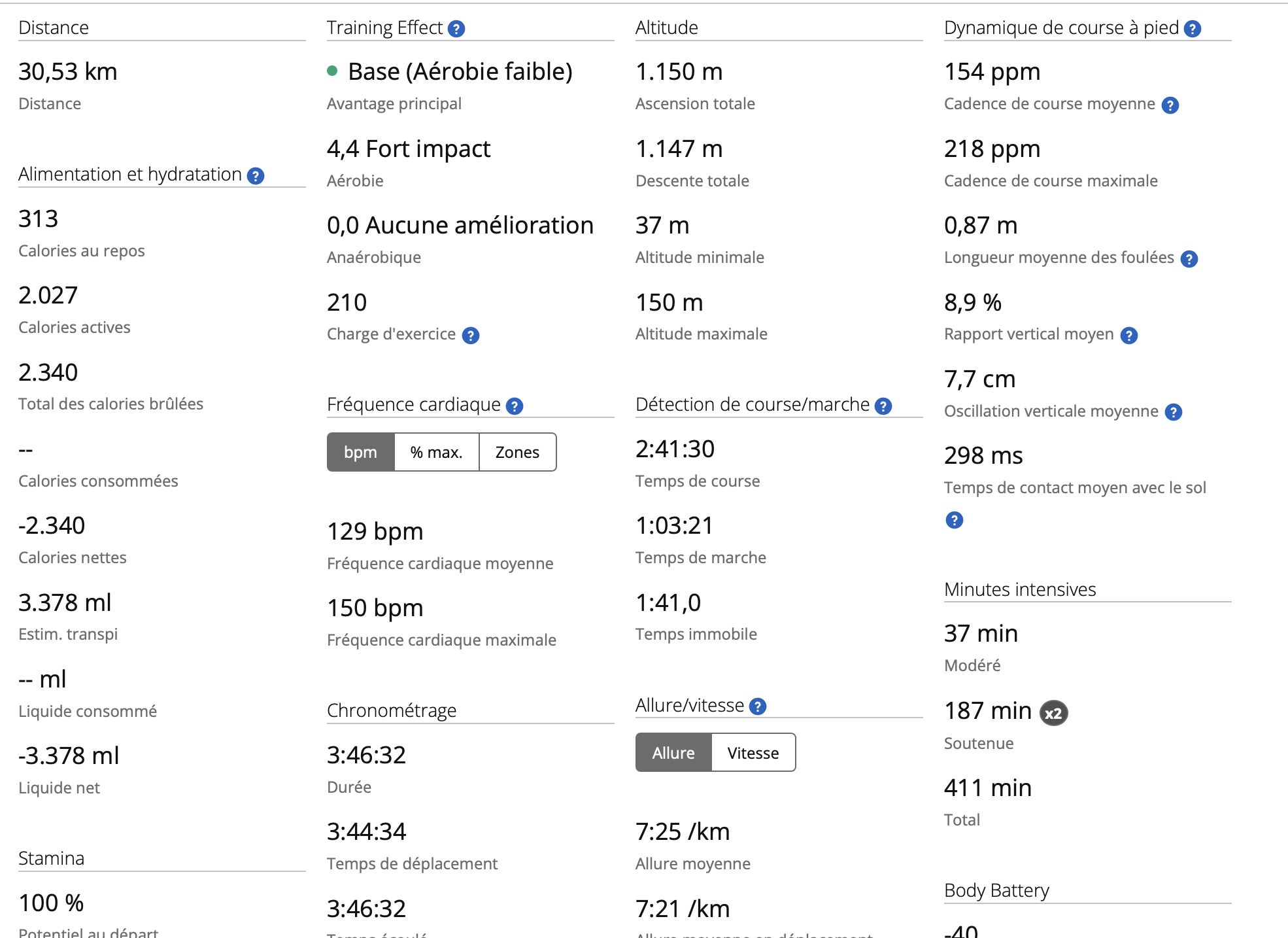
Garmin summary of the peak run: 30.53 km, 3h46, 1150 m elevation gain, avg HR 129 bpm, 2340 kcal — the full nutrition protocol, tested in real conditions.
The race-day plan#
The final nutrition plan (v3) was remarkably precise:
| Parameter | Value |
|---|---|
| Estimated expenditure | ~8,500-9,500 kcal |
| Targeted intake | ~4,300-4,800 kcal (290-320 kcal/h) |
| Carbohydrates | 70-80 g/h (dual transporter: glucose + fructose) |
| Hydration | 500-750 ml/h, ~8.5-10 L total |
| Sodium | 500-700 mg/L (Aptonia Electrolytes) |
| Total cost | ~€81 |
The products were chosen with precision: Baouw gels (fructose), Aptonia fruit pastes (glucose), Baouw savory purees (sodium + anti-nausea), crunchy bars at the end of the race. All for ~1.9 kg of food in the pack.
One important point: the protocol was adapted to minimize potassium intake during the race (low-K protocol), with precise choices: Aptonia lemon electrolytes, pear-apple-mint compotes, bananas and dates banned from aid stations, replaced by oranges. This kind of detail is exactly what a nutritionist agent can track and verify.
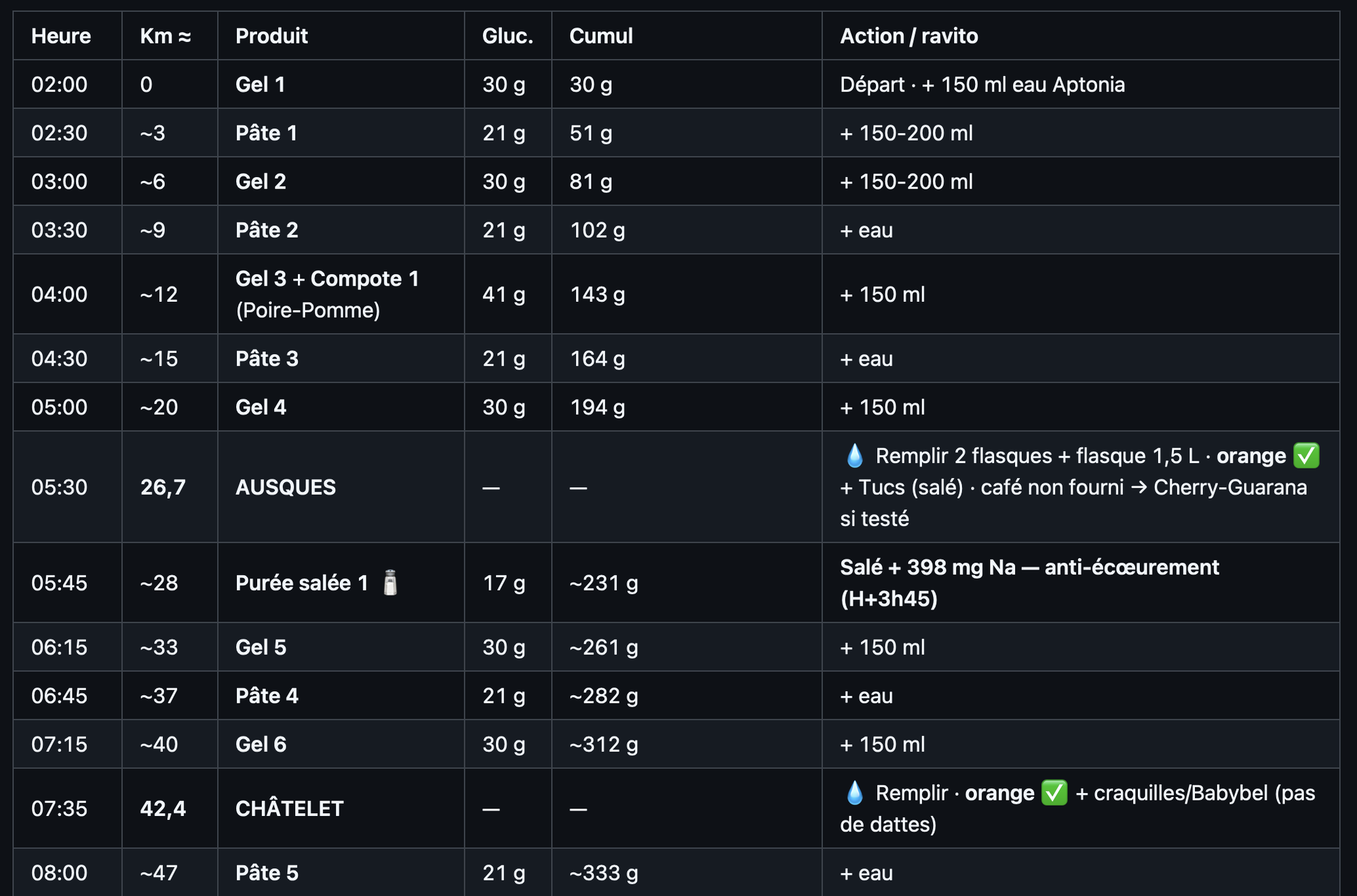
The hour-by-hour nutrition plan: product, carbs, cumulative total and action at each aid station — with reminders to refill flasks and the low-K protocol (orange instead of banana/date).
Analyzing my condition via Garmin sync#
Every morning, the medical agent analyzed my Garmin data: HRV, resting HR, sleep, readiness, ACWR, VO2max. These reports guided training decisions.
The VO2max trend#
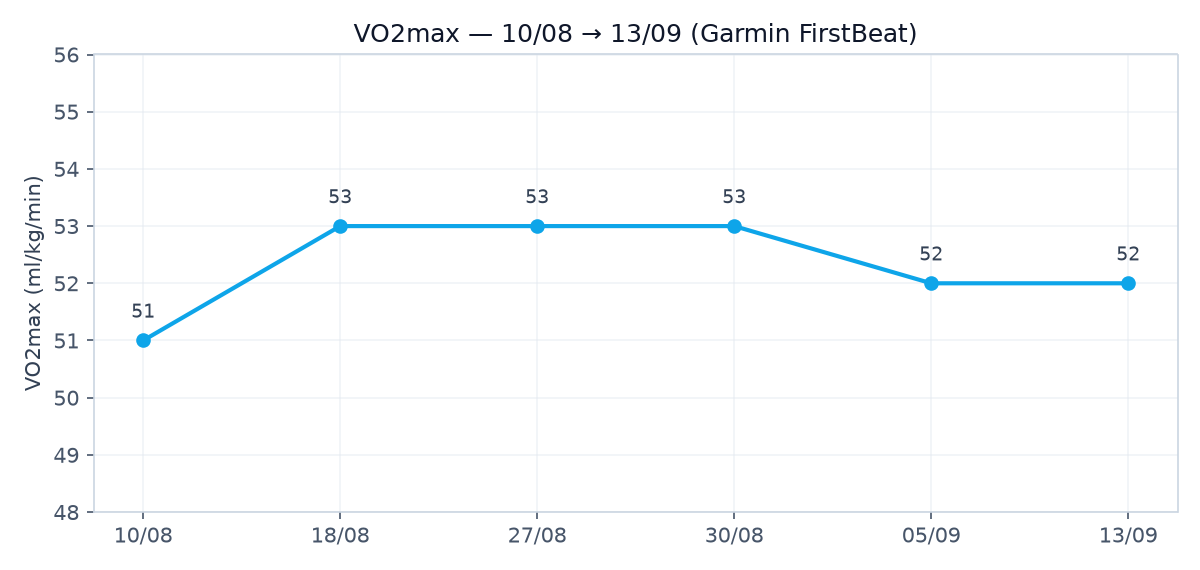
VO2max went from 51 to 53 ml/kg/min in August, then stabilized at 52 — a nice progression over the period.
Heart rate zones recalculated, not Garmin’s#
One interesting point: the zones used to drive training were not Garmin/Strava’s. In April, the coach agent recalculated my zones from my own data (max HR 177, resting HR 40-45) using the Karvonen method (based on heart rate reserve), which differs from the default percentage-of-max-HR method.
| Zone | Garmin/Strava (% max HR) | Karvonen (% reserve) |
|---|---|---|
| Z1 | <115 | 109-122 |
| Z2 | 116-143 | 122-136 |
| Z3 | 144-158 | 136-150 |
| Z4 | 159-172 | 150-163 |
| Z5 | >173 | 163-177 |
The difference is subtle but important for an ultra: the Karvonen method factors in resting HR, so the zones are more personalized than a simple percentage of max HR. Concretely, the top of Z2 went from 143 bpm (Garmin) to 133-136 bpm — and it’s this stricter value that guided my long runs and the “never above 140 bpm” rule on race day. The result speaks for itself: 74.8% of the time in Z1+Z2 during the race.
💡 Why is it different, and which is better? The % max HR method is simple and universal, but ignores resting HR: two runners with the same max HR but very different resting HR get the same zones, even though their physiology differs. The Karvonen method (HR reserve = max HR − resting HR) is more accurate for trained athletes, whose resting HR is low (40-45 here) — that’s why the Karvonen zones are lower and stricter. The point of redoing this calculation: it’s free, based on your own data, and it prevents training too hard in “apparent” Z2 when you’re already physiologically in Z3. The limit: it remains an estimate — a lactate threshold test (or a field test like a 30-minute effort) would refine the values further.
Race day: controlled cardio#
On race day, the data analysis confirmed impeccable heart rate management:

The heart rate trace across the 15h26 of racing: a broadly stable plateau between 115 and 135 bpm, a few isolated spikes above 140 bpm (steep climbs, surges), and above all no upward drift over time — the sign that the pace was sustainable.
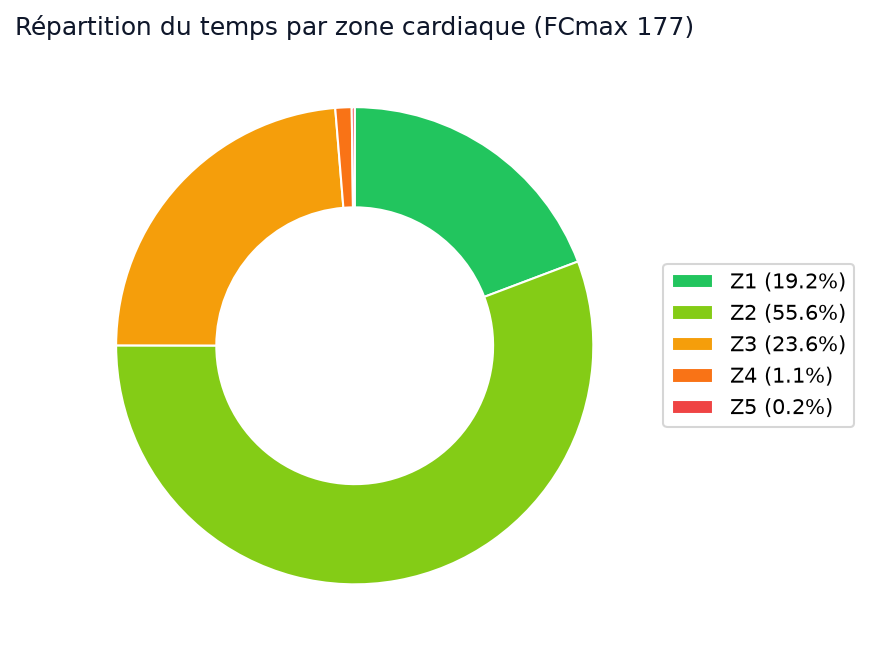
- 74.8% of the time in Z1+Z2 (≤133 bpm), 63% under 130 bpm
- Average HR: 125 bpm over 15h26
- No cardiac drift: the average HR decreases over the blocks (126 → 115 bpm), a sign of healthy management

Race planning#
GPX analysis#
For every important course, the course-strategist agent analyzed the GPX: distance, elevation gain, profile, slopes, terrain. One example: the evaluation of the Mont-de-l’Enclus course for the Aug 30 peak run — 35.6 km analyzed, verdict “too long”, cut recommended to 30-32 km, with the exact cut point (km 30.1) and the return route. That level of detail is what makes the tool useful.
The pace and aid station plan (D-1)#
The day before, the final plan was ready: a per-segment table with target paces, realistic passages and barriers, plus a self-assessment at each aid station (“where should I be?”).
| Segment | Km | Target pace | Realistic passage | Barrier |
|---|---|---|---|---|
| Start → Ausques | 26.7 | 7:52/km | 05:30 | — |
| Ausques → Châtelet | 15.7 | 7:58/km | 07:35 | 09:00 |
| Châtelet → Sangatte | 14.8 | 7:46/km | 09:30 | — |
| Sangatte → Hervelinghen | 20.4 | 8:05/km | 12:15 | 14:30 |
| Hervelinghen → Cap Gris-Nez | 16.5 | 8:11/km | 14:30 | 17:00 |
| Cap Gris-Nez → Finish | 15.7 | 9:33/km | 17:00 | 19:35 |
Weather, until the day before#
The weather was tracked from D-7 to D-1, with successive revalidations: D-3 (Open-Meteo, 🟠 12.8 mm rain) → D-2 (wttr.in, 🟡) → eve (🟡 confirmed: dry start, 0.5 mm rain peak at 09:00, 43-44 km/h gusts in the morning). The final decision: light waterproof jacket, headlamp mandatory (4% moon), waterproof ziplocs for nutrition.
Gear: 2 packs, a drop bag#
The gear plan included a drop bag at Hervelinghen (km 77.6) with the second-half supplies, and a carried water capacity of 2.5 L (2×500 ml flasks + 1×1.5 L flask) — all with existing gear, no purchase needed.
Race day: forecast vs reality#
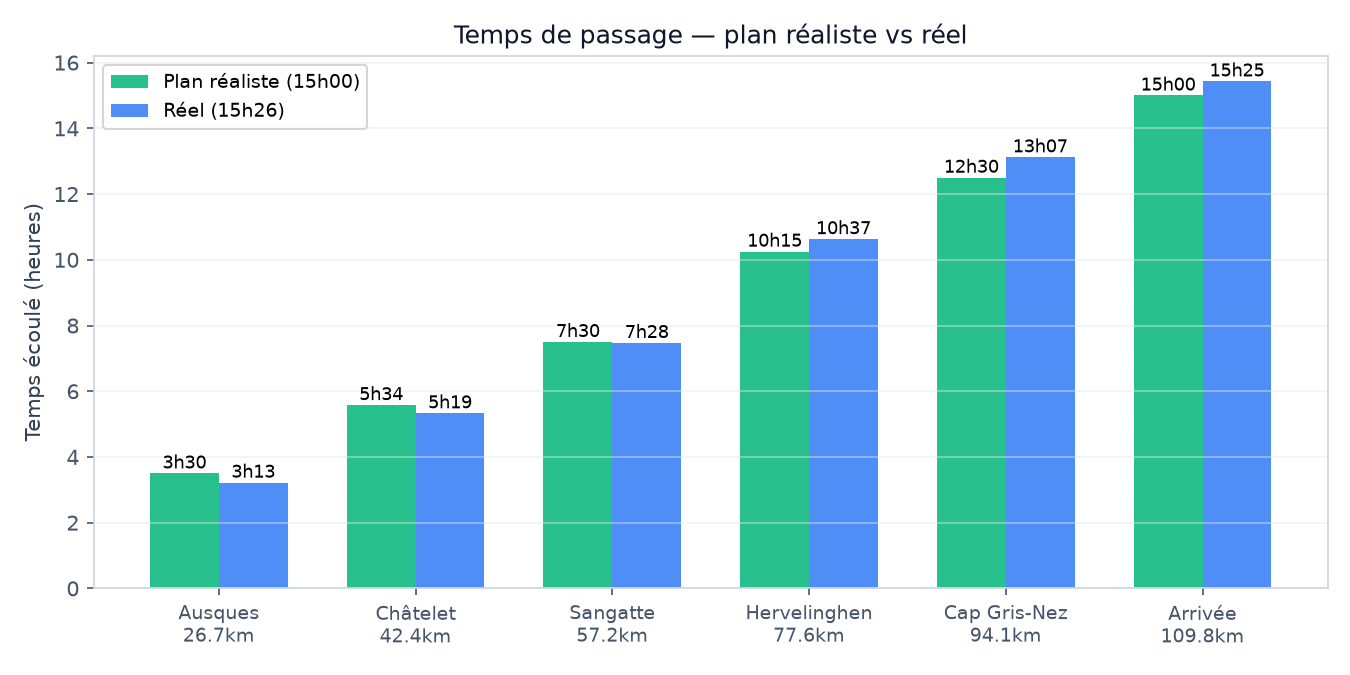
The outcome is told by the forecast vs reality comparison:

The official race summary: 109.71 km, 15h26:51, average pace 8:27/km, +1992 m elevation gain, 7,955 calories — with the route across the Opal Coast, from Wimereux south past Boulogne-sur-Mer and back, coloured from slowest (blue) to fastest (red).
| Time | Finish | Pace | |
|---|---|---|---|
| 🚀 Ambitious | 12h49 | ~14:49 | 7:00/km |
| 🟡 Realistic plan | 15h00 | ~17:00 | 8:12/km |
| 📍 REAL | 15h26 | 17:26 | 8:27/km |
| 🟢 Safe | 16h00 | ~18:00 | 8:44/km |
+26 minutes vs the target (+3%) — judged a very solid execution. Why the gap?
- The course was harder than expected: real elevation gain of 1992 m vs 1768 m (+13%), ~10-15 min.
- Forced walking on the climbs (km 50-51, 61, 74, 77).
- An isolated stomach issue at km 48.6 (~3 min).
- Rain and gusts around 09:00 on the Châtelet → Sangatte segment.
But most importantly: all barriers were passed with very large margins (up to +2h09 at the finish), the cardio remained impeccable, and the finale was solid: last segment at -10 min vs plan, despite the last 3 km of dunes walked.
Recovery, tracked day by day#
After the race, the medical agent kept tracking recovery:
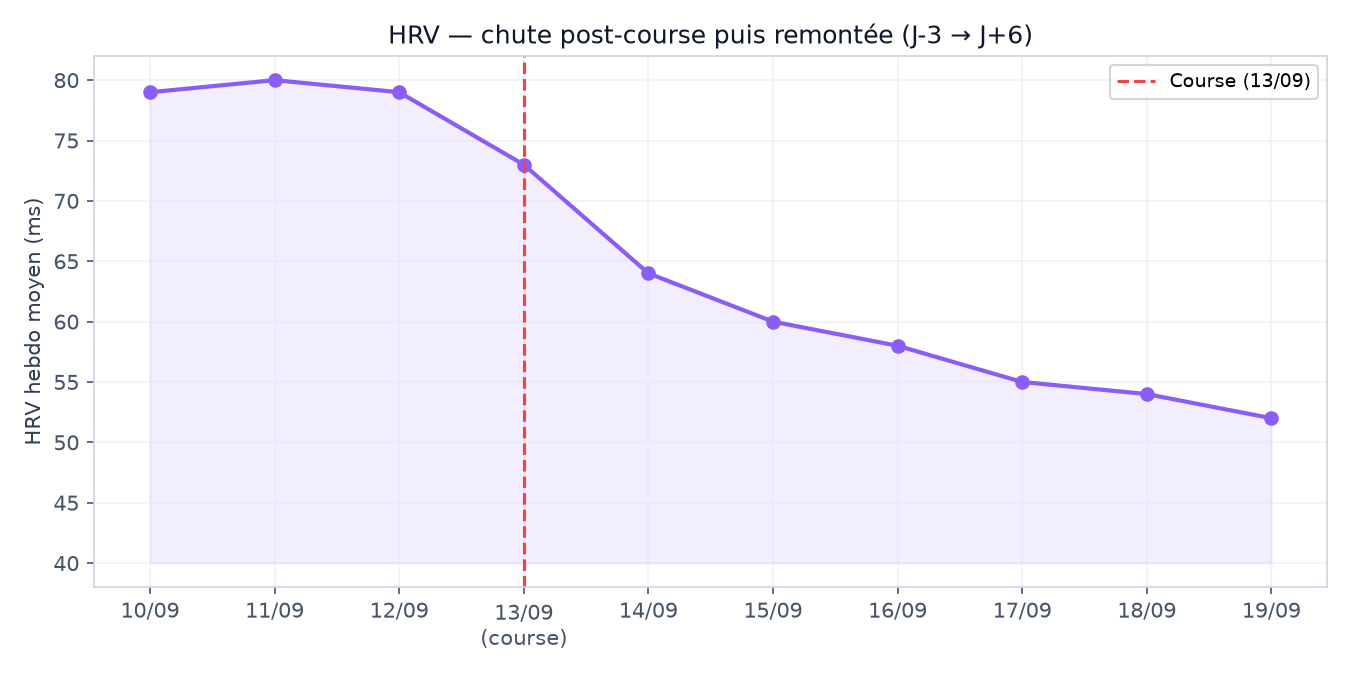
- D+1: readiness 1/100, estimated recovery time 96h, collapsed HRV (30 ms), 5.1h sleep (score 28) — the body gave everything.
- D+3: still recovering, HRV progressively rising.
- D+5: readiness 61/100, 7.25h sleep (score 86), HRV 69 ms — first easy jog confirmed.
The HRR (heart rate recovery) of 7 bpm at the end of the race was the expected signal of a maximal effort — normal after 15h26 of effort.
What I take away#
Preparing for an ultra-trail is a job of planning, listening and constant adjustment. What ai-running-coach brought me:
- Structure: every decision documented, every plan versioned, in markdown.
- Analysis discipline: Garmin data (HRV, readiness, HR, VO2max) turned into concrete decisions.
- Surgical precision: from the cut point of a GPX to the grams of carbs per hour.
- Peace of mind on race day: when everything is planned and tested, all that’s left is execution.
The result: 15h26 for 109.7 km and +1992 m, controlled cardio, no barrier ever threatened, and a tracked, controlled recovery. I can’t guarantee AI makes you an ultra finisher — but it can certainly help you get there.
The project is open-source and available on GitHub, with the documentation and a one-command install script. If you’re preparing a trail or ultra goal, feel free to try it — and to contribute!