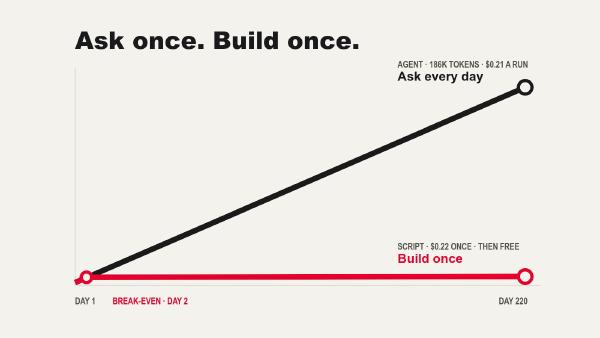
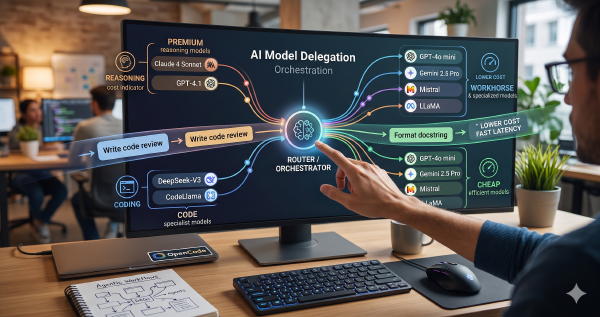
Asking an agent to block focus time, summarise yesterday’s numbers or find a meeting slot works, but you pay for it every time, and the answer changes. I measured 14 Claude Code runs on three everyday jobs. Writing the script once costs about as much as asking once. With an interactive calculator, a checklist, and my own projects as examples.
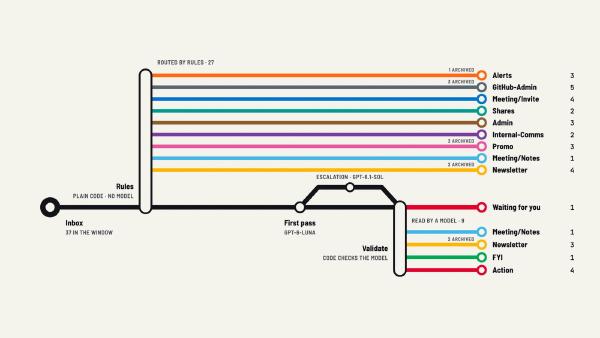
A Gmail triage that costs cents. Deterministic rules handle the routine mail, Claude Haiku looks only at what’s left, Claude Sonnet only at what Haiku isn’t sure about, and code validates every answer. Requests become Google Tasks with a due date. With a real run on my inbox, a from-zero install with Homebrew, and a few thoughts on letting an AI answer your mail.
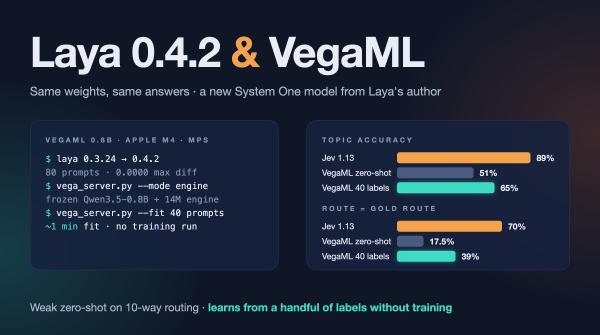
Laya shipped eight releases and nothing moved for routing. Its author also shipped VegaML, a decision model that answers by letting a particle settle in a valley. Zero-shot it isn’t ready for my router, but it can learn from 40 labels in a minute, which none of the other models can do.
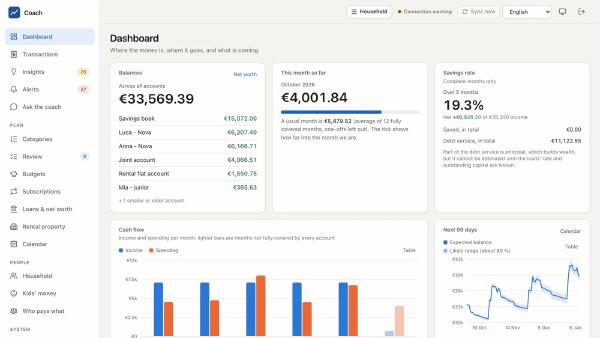
A self-hosted coach for your household’s money. PSD2 bank sync through Enable Banking, an encrypted local database, a one-time login link or a passkey, and a language model that only ever receives redacted, pseudonymised, already computed figures. With real examples of what stays on your machine and what is sent.
A video that is a web page: frames drawn in JavaScript, a free synthetic voice, an agent doing the heavy lifting. The method, every free TTS option worth knowing (and which ones you are actually allowed to publish), and a step-by-step example you can watch right here.
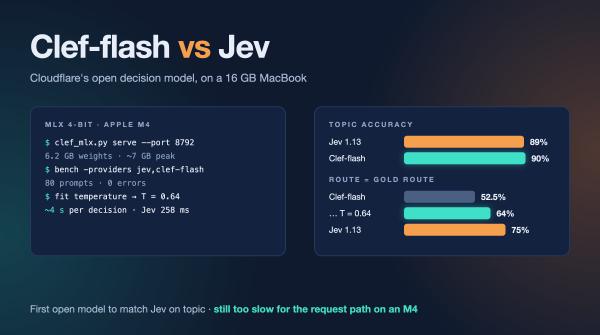
Three days after Cloudflare’s announcement, Clef-flash went through the same 80-prompt benchmark as Jev, Laya, Von and Kev. 90% topic accuracy, a confidence temperature that brings it level with Jev on calibration, and one problem no temperature can fix on a laptop.
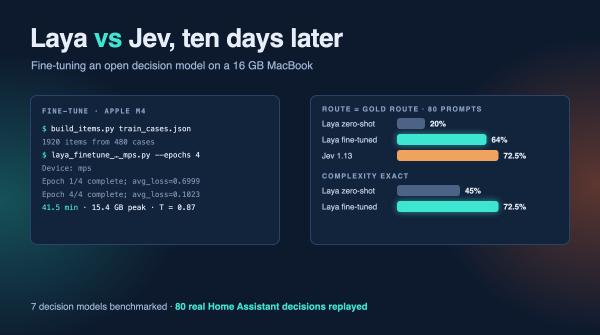
Laya says “fine-tune me”, so I did, on a 16 GB MacBook. Here is the recipe, how long it takes, what it changes on the 80-prompt benchmark, and why my house still runs on Jev.
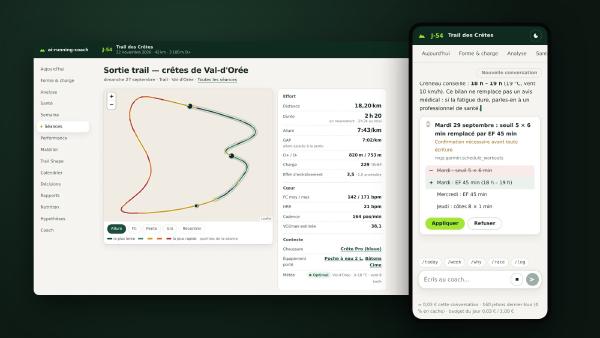
A chat with the coach inside the dashboard, a GPS map on every session, a calorie model that checks Garmin’s numbers, a full gear locker with photo inspections, running dynamics, a second contributor, and “The Trail”, a video series drawn in JavaScript that you can watch right here.
A dashboard, a pile of new metrics, guardrails that can say no, and a coach that lives on a Linux box at home and answers me from my phone. Here is what changed in ai-running-coach since the ultra, and why the automatic sync runs on cron instead of a Claude routine.
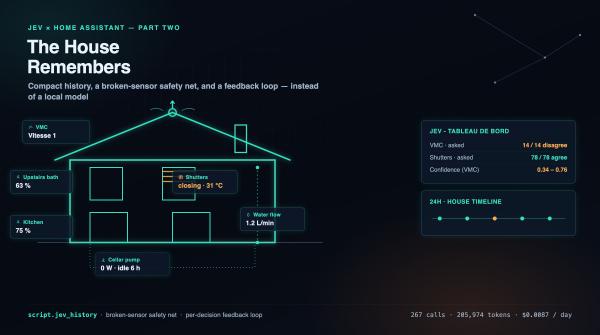
The fix for “Jev has no memory” was never a different model. It was giving Jev a memory. Here is the history script, the feedback loop, and what the live scoreboard already disagrees about.
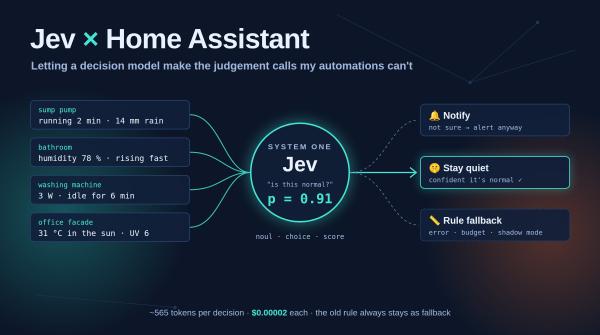
My automations are good at thresholds and bad at context. Jev answers typed questions with a calibrated probability, for about two thousandths of a cent each. Here is how I wired it into Home Assistant with the old rules kept as a safety net, and what it really costs.
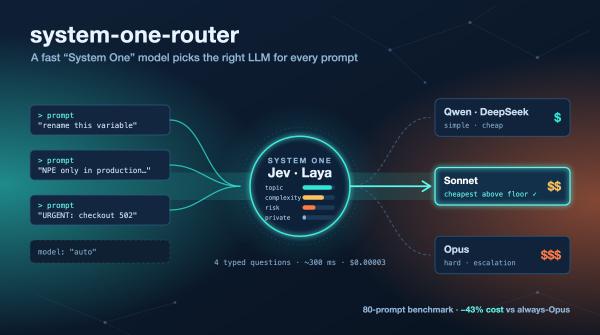
My first model router let an LLM read a prompt file and pick an agent. This one asks a “System One” decision model four typed questions, scores the models with plain arithmetic, and publishes a benchmark to prove it works (and to show where it doesn’t).