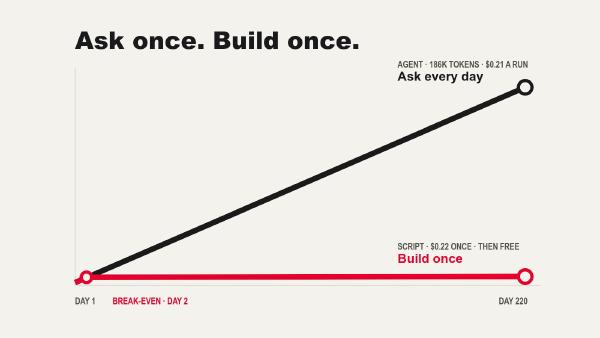
Asking an agent to block focus time, summarise yesterday’s numbers or find a meeting slot works, but you pay for it every time, and the answer changes. I measured 14 Claude Code runs on three everyday jobs. Writing the script once costs about as much as asking once. With an interactive calculator, a checklist, and my own projects as examples.
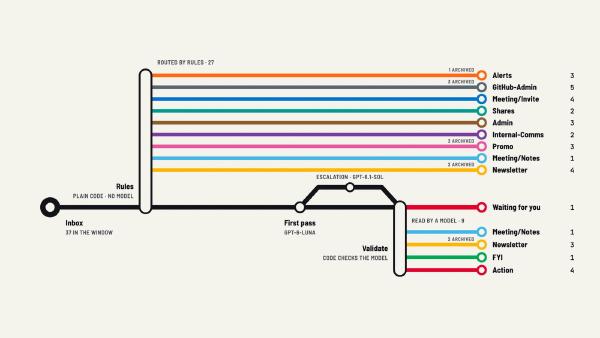
A Gmail triage that costs cents. Deterministic rules handle the routine mail, Claude Haiku looks only at what’s left, Claude Sonnet only at what Haiku isn’t sure about, and code validates every answer. Requests become Google Tasks with a due date. With a real run on my inbox, a from-zero install with Homebrew, and a few thoughts on letting an AI answer your mail.
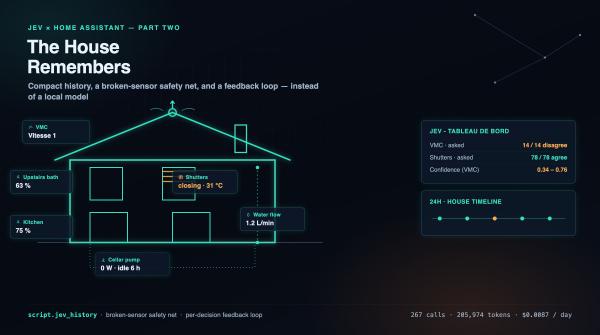
The fix for “Jev has no memory” was never a different model. It was giving Jev a memory. Here is the history script, the feedback loop, and what the live scoreboard already disagrees about.
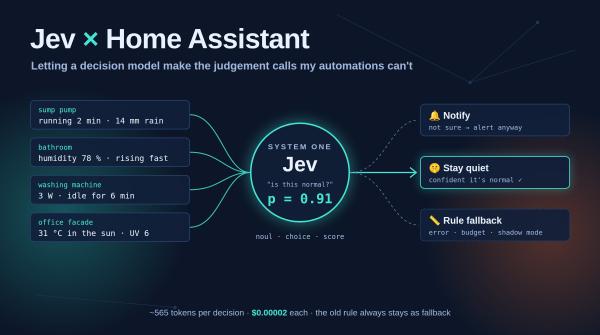
My automations are good at thresholds and bad at context. Jev answers typed questions with a calibrated probability, for about two thousandths of a cent each. Here is how I wired it into Home Assistant with the old rules kept as a safety net, and what it really costs.
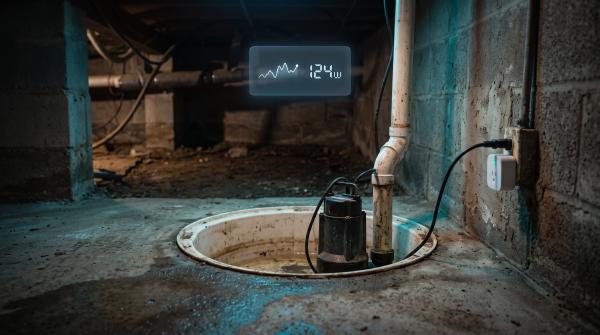
A Zigbee smart plug, nine automations, and one invisible pump that saves the house from flooding - the “invisible device” pattern, monitored with Home Assistant.